Role of Virtual Labs in Engineering Education: Transforming Practical Learning in 2026
Introduction
Engineering education is not just about understanding theories, formulas, and technical concepts. It is about applying knowledge through practical experiments, solving real-world problems, and developing technical skills.
Traditionally, engineering students have depended on physical laboratories to understand electrical circuits, mechanical systems, electronics, programming, and other technical subjects. However, limited equipment, expensive infrastructure, laboratory schedules, and maintenance requirements can create challenges for educational institutions.
This is where virtual labs in engineering education are becoming increasingly important.
Virtual laboratories provide interactive digital environments where students can perform simulated experiments, explore engineering concepts, analyze results, and practice technical procedures.
With modern platforms like QUATLAB, practical learning can become more flexible, interactive, and accessible for engineering students and educators.
1. What Are Virtual Labs in Engineering Education?
Virtual engineering laboratories are digital platforms that allow students to perform experiments using computer-based simulations and interactive tools.
Instead of depending entirely on physical laboratory equipment, students can explore engineering concepts through digital instruments, simulation interfaces, and virtual experimental environments.
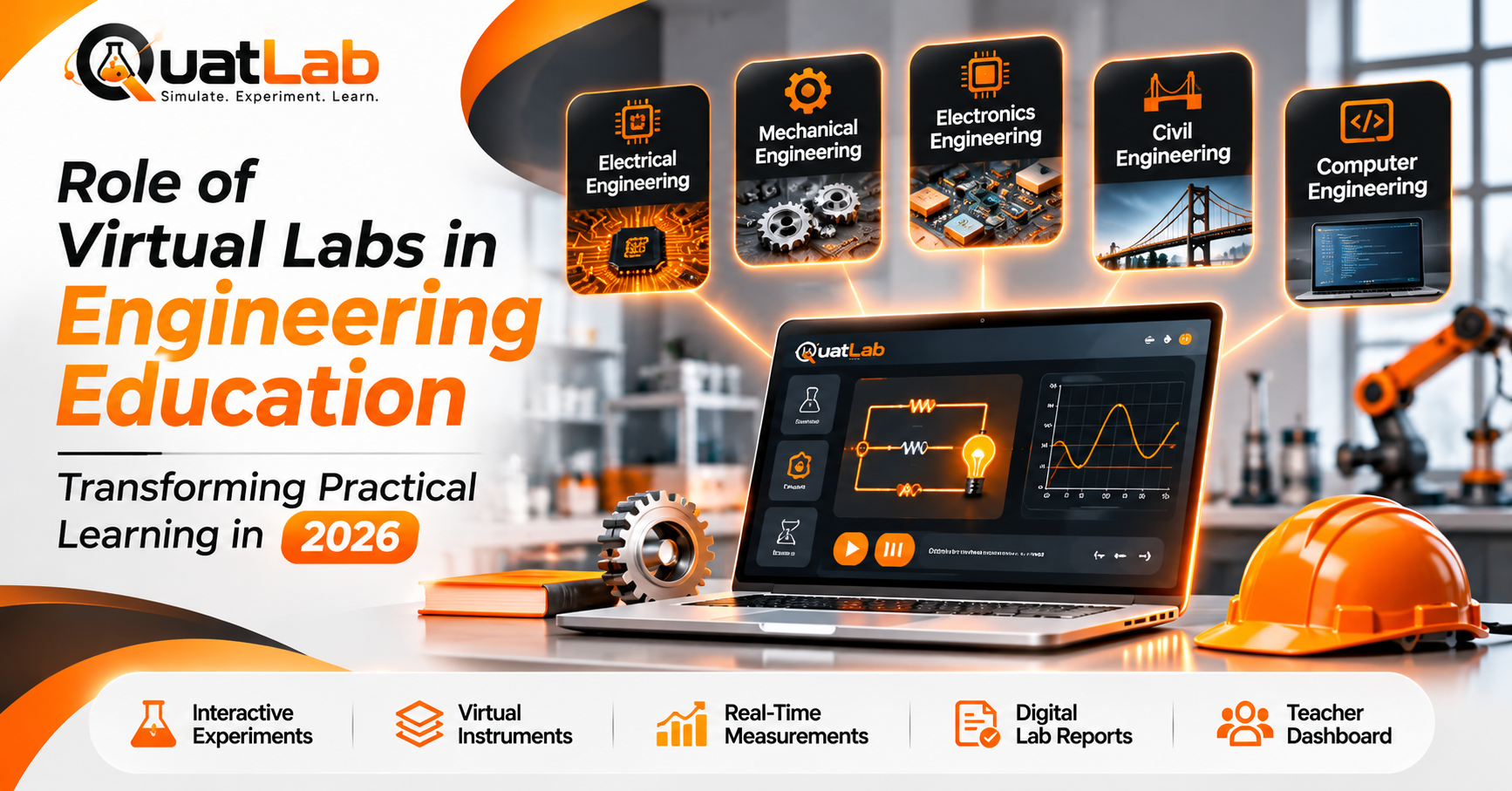
These laboratories can support different engineering disciplines, including:
-
Electrical Engineering
-
Mechanical Engineering
-
Electronics Engineering
-
Civil Engineering
-
Computer Science Engineering
Virtual labs help students connect theoretical knowledge with practical applications through interactive learning experiences.
2. Why Engineering Students Need Practical Learning
Engineering students must understand how theoretical concepts work in real-world situations.
Reading textbooks and attending lectures provide essential knowledge, but practical experimentation helps learners understand how technical systems behave.
For example:
-
Electrical engineering students need to understand circuits, voltage, current, and resistance.
-
Mechanical engineering students need to explore motion, forces, and mechanical systems.
-
Electronics students need to understand electronic components and circuit behavior.
-
Computer science students need opportunities to practice programming and logical problem-solving.
Virtual laboratories provide additional opportunities to explore these concepts through digital experiments.
3. Major Benefits of Virtual Labs for Engineering Students
A. Learn Through Interactive Experiments
Virtual laboratories allow students to interact with digital experimental environments rather than simply reading theoretical explanations.
Students can explore different parameters, perform simulations, and observe how changes affect experimental outcomes.
This makes technical learning more engaging and practical.
B. Practice Experiments Anytime
Traditional laboratories usually operate according to fixed schedules.
Virtual laboratories can provide flexible access to supported experiments, allowing students to practice beyond regular laboratory hours.
This flexibility is especially useful for students who need additional time to understand complex engineering concepts.
C. Understand Complex Engineering Concepts
Some engineering concepts are difficult to visualize through textbooks alone.
Digital simulations can represent circuits, scientific processes, measurements, and technical systems in an interactive format.
Students can better understand relationships between different parameters by observing simulated results.
D. Repeat Experiments and Improve Skills
Learning engineering requires continuous practice.
Virtual labs allow students to repeat supported experiments, change parameters, compare outcomes, and understand mistakes.
Repeated experimentation encourages independent learning and improves conceptual understanding.
E. Reduce Dependence on Physical Laboratory Resources
Setting up engineering laboratories requires equipment, instruments, infrastructure, maintenance, and regular upgrades.
Virtual laboratories can complement physical facilities by providing digital alternatives for selected practical activities.
This can help institutions expand practical learning opportunities without depending entirely on additional physical equipment.
F. Support Safe Experimentation
Some engineering experiments involve electrical components, high temperatures, machinery, or other potential risks.
Virtual simulations provide a controlled environment for exploring certain procedures without direct exposure to physical hazards.
However, virtual practice should complement real-world safety training and supervised equipment handling.
4. Applications of Virtual Labs Across Engineering Disciplines
Virtual laboratories can support practical learning across several engineering fields.
Electrical Engineering Virtual Labs
Electrical engineering students can explore concepts such as:
-
Electrical circuits
-
Voltage and current measurements
-
Ohm's Law
-
Circuit analysis
-
Electrical measurements
-
Power systems fundamentals
Simulations help students understand how electrical parameters interact within different circuit configurations.
Mechanical Engineering Virtual Labs
Mechanical engineering involves understanding physical systems, forces, movement, and mechanical processes.
Virtual experiments can help students explore:
-
Mechanics
-
Motion and forces
-
Thermodynamics
-
Fluid mechanics
-
Mechanical systems
-
Engineering measurements
Electronics Engineering Virtual Labs
Electronics students work with circuits, semiconductor devices, and electronic components.
Virtual laboratories can support learning in:
-
Analog electronics
-
Digital electronics
-
Logic gates
-
Circuit analysis
-
Sensors
-
Microcontrollers
Civil Engineering Virtual Labs
Civil engineering students study structures, materials, construction processes, and infrastructure.
Digital learning environments can support selected topics such as:
-
Structural mechanics
-
Material testing concepts
-
Surveying principles
-
Construction technology
-
Engineering measurements
Computer Science Engineering Virtual Labs
Computer science students need practical experience with programming, algorithms, and computing systems.
Digital laboratory activities can support:
-
Programming fundamentals
-
Algorithm development
-
Database concepts
-
Computer networks
-
Software development
-
Logical problem-solving
5. How Virtual Labs Improve the Teaching Experience
Virtual laboratories are useful for educators as well as students.
Teachers can use interactive simulations to explain complex engineering concepts and provide additional practical learning opportunities.
Depending on the platform, educators can:
-
Assign experiments to students.
-
Demonstrate technical concepts.
-
Evaluate practical understanding.
-
Monitor experiment completion.
-
Review digital laboratory reports.
-
Track student performance.
These capabilities can help teachers organize practical learning activities more effectively.
6. The Role of Digital Technology in Engineering Laboratories
Modern virtual laboratories combine different digital technologies to create interactive learning experiences.
Interactive Simulations
Students can perform experiments using virtual controls and observe simulated results.
Real-Time Data Visualization
Digital measurements and graphs can help learners understand experimental relationships.
Digital Assessments
Quizzes and practical assessments can help evaluate students' understanding of engineering concepts.
Artificial Intelligence
AI-powered educational tools can support concept explanations, guided learning, and assistance with technical questions.
Learning Analytics
Digital learning platforms can help educators understand experiment completion, assessment performance, and student progress.
These technologies are helping educational institutions explore new approaches to practical engineering education.
7. How QUATLAB Supports Engineering Practical Learning
QUATLAB provides a virtual laboratory learning environment designed to make practical education more interactive and accessible.
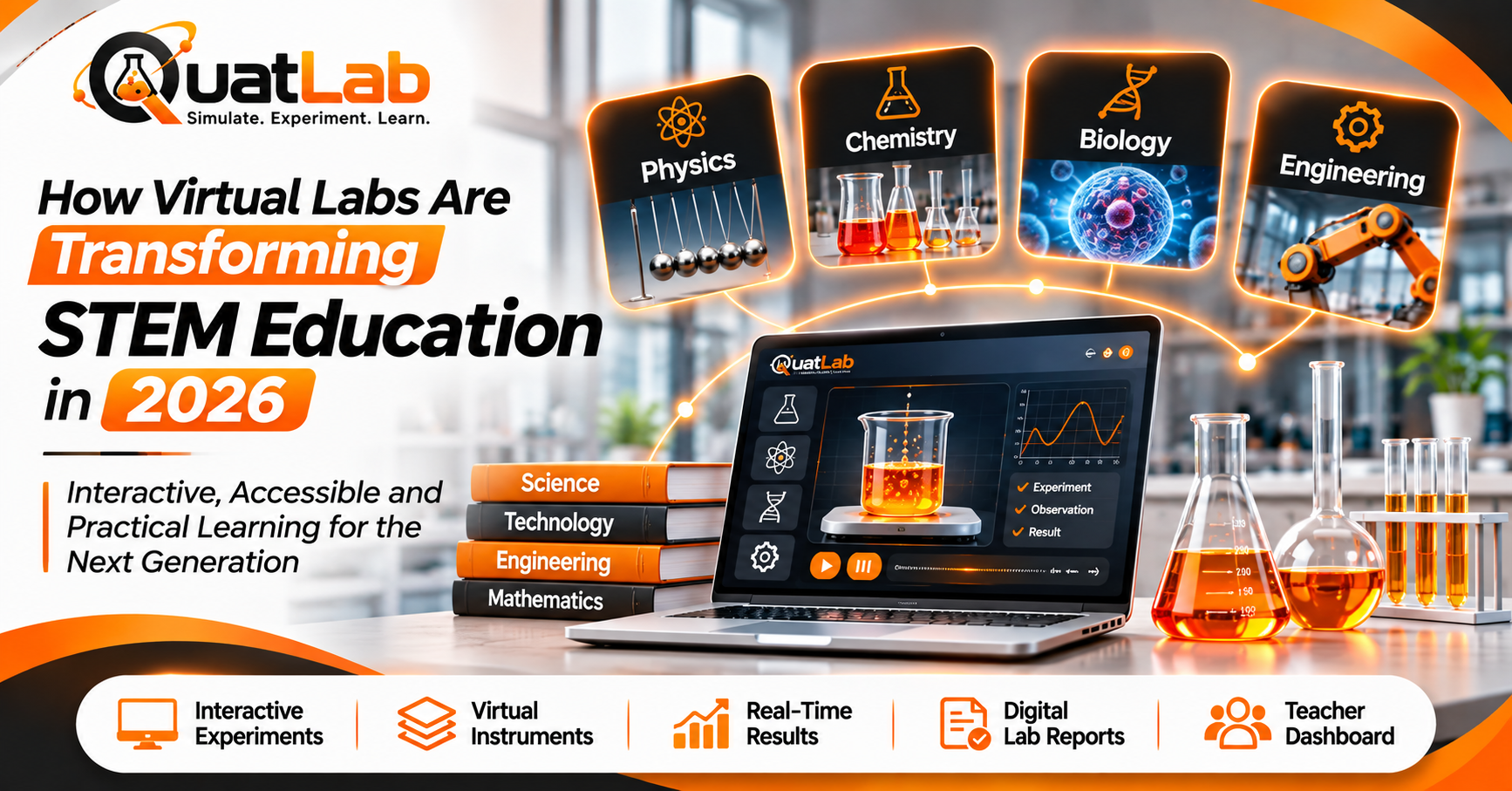
The platform brings together multiple disciplines, including Physics, Chemistry, Biology, Electronics, and Engineering.
Its digital learning approach supports important practical learning activities.
Key QUATLAB Features
Interactive Experiments: Explore scientific and engineering concepts through digital simulations.
Virtual Instruments: Work with digital laboratory instruments and interactive controls.
Real-Time Measurements: Observe experimental values and changing parameters.
Graphs and Analysis: Understand experimental data through visual representations.
Digital Lab Reports: Organize experiment objectives, procedures, observations, calculations, and results.
Digital Assessments: Evaluate theoretical knowledge and practical understanding.
Teacher Dashboard: Support experiment assignments and student progress monitoring.
With these capabilities, QUATLAB aims to support students, educators, and institutions in creating more connected practical learning experiences.
8. Virtual Labs vs Physical Engineering Laboratories
Virtual and physical laboratories serve different educational purposes.
| Virtual Laboratories | Physical Laboratories |
|---|---|
| Digital simulations | Real equipment |
| Flexible access | Scheduled access |
| Repeatable simulations | Physical repetition |
| Digital measurements | Instrument-based measurements |
| Controlled simulated environment | Real-world environment |
| Digital learning activities | Hands-on practical activities |
Both approaches are important for engineering education.
Virtual labs can help students understand concepts and prepare for practical activities, while physical laboratories provide essential experience with real instruments and equipment.
A blended learning approach can combine the advantages of both environments.
9. The Future of Engineering Education
Engineering education is continuously evolving with advancements in digital technology, simulation software, artificial intelligence, and online learning platforms.
Educational institutions are exploring new ways to provide students with flexible and interactive practical learning experiences.
Virtual laboratories can become an important part of this transformation by supporting:
-
Interactive engineering experiments.
-
Digital practical learning.
-
Simulation-based education.
-
Flexible learning environments.
-
Technology-supported assessments.
-
Data-driven academic monitoring.
The future of engineering education will likely involve a combination of physical laboratories, digital simulations, and technology-supported teaching methods.
Conclusion
Virtual labs are creating new opportunities for practical engineering education.
They help students explore technical concepts, perform simulated experiments, repeat learning activities, and understand experimental results in a digital environment.
For engineering colleges, universities, and educational institutions, virtual laboratories can complement existing physical laboratory facilities and expand practical learning opportunities.
As digital education continues to evolve, platforms like QUATLAB can support a smarter and more interactive approach to engineering education.
Simulate. Experiment. Learn.
Discover a smarter approach to practical learning with QUATLAB.
Visit: https://www.quatlab.com/
Frequently Asked Questions (FAQs)
1. What are virtual labs in engineering education?
Virtual labs are digital learning environments where engineering students perform simulated experiments to understand technical concepts and practical procedures.
2. How do virtual labs help engineering students?
They provide interactive experiments, repeatable simulations, digital measurements, and additional opportunities to practice engineering concepts.
3. Which engineering subjects can use virtual laboratories?
Virtual laboratories can support Electrical, Mechanical, Electronics, Civil, and Computer Science Engineering subjects.
4. Are virtual labs better than physical engineering labs?
Both have different advantages. Virtual labs provide flexible simulation-based learning, while physical labs develop hands-on equipment-handling skills.
5. Can engineering students practice experiments online?
Yes. Students can access supported virtual experiments through compatible devices and internet connectivity.
6. How do virtual labs benefit engineering colleges?
They can help institutions expand practical learning opportunities, complement existing laboratories, and support digital assessments and student progress monitoring.
7. What is QUATLAB?
QUATLAB is a virtual laboratory platform designed to support interactive experiments and digital practical learning across multiple scientific and engineering disciplines.