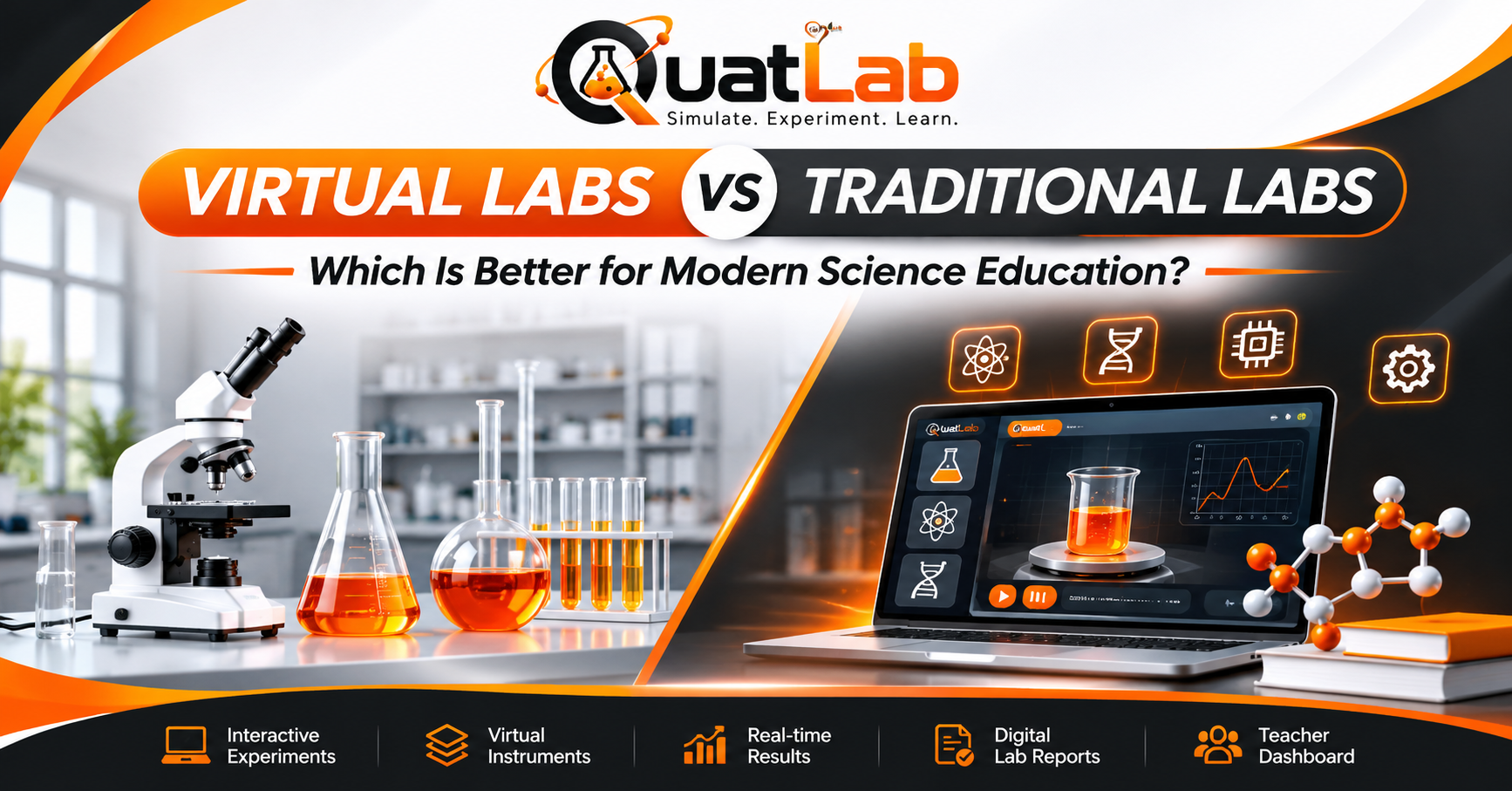
Virtual Labs vs Traditional Labs: Which Is Better for Modern Science Education?
Introduction
Practical learning plays an essential role in science, technology and engineering education. Students understand complex concepts more effectively when they can perform experiments, observe results and apply theoretical knowledge in real-world situations.
Traditionally, schools, colleges and universities have relied on physical laboratories to provide hands-on learning experiences. However, limited equipment, infrastructure costs, restricted laboratory hours and safety considerations can sometimes make practical education challenging.
With technological advancements, virtual laboratories are transforming the way students approach practical learning. They provide interactive digital environments where learners can perform simulated experiments, explore scientific concepts and practice different procedures.
But how do virtual labs compare with traditional laboratories? Let's explore their differences, advantages and limitations.
What Are Traditional Laboratories?
Traditional laboratories are physical spaces equipped with scientific instruments, chemicals, machinery and other resources required to conduct experiments.
Students work with actual laboratory equipment under the guidance of teachers or laboratory instructors.
Key Features of Traditional Labs
-
Physical scientific equipment and instruments.
-
Direct observation of real experiments.
-
Hands-on practical experience.
-
Teacher-supervised laboratory activities.
-
Physical recording of observations and results.
Traditional laboratories remain important because they allow students to develop practical skills involving real equipment, materials and experimental procedures.
However, maintaining these facilities requires infrastructure, equipment, regular maintenance and appropriate safety arrangements.
What Are Virtual Laboratories?
Virtual laboratories are digital learning environments that allow students to perform experiments through interactive simulations.
Instead of relying entirely on physical equipment, students use digital instruments, simulation interfaces and interactive controls to explore scientific principles.
Virtual labs make it possible to repeat experiments, modify parameters, observe simulated outcomes and understand complex concepts in a controlled digital environment.
Key Features of Virtual Labs
-
Interactive scientific simulations.
-
Digital laboratory instruments.
-
Real-time or dynamically updated experimental values.
-
Repeatable virtual experiments.
-
Graphs and data analysis.
-
Digital assessments and laboratory reports.
-
Flexible learning access.
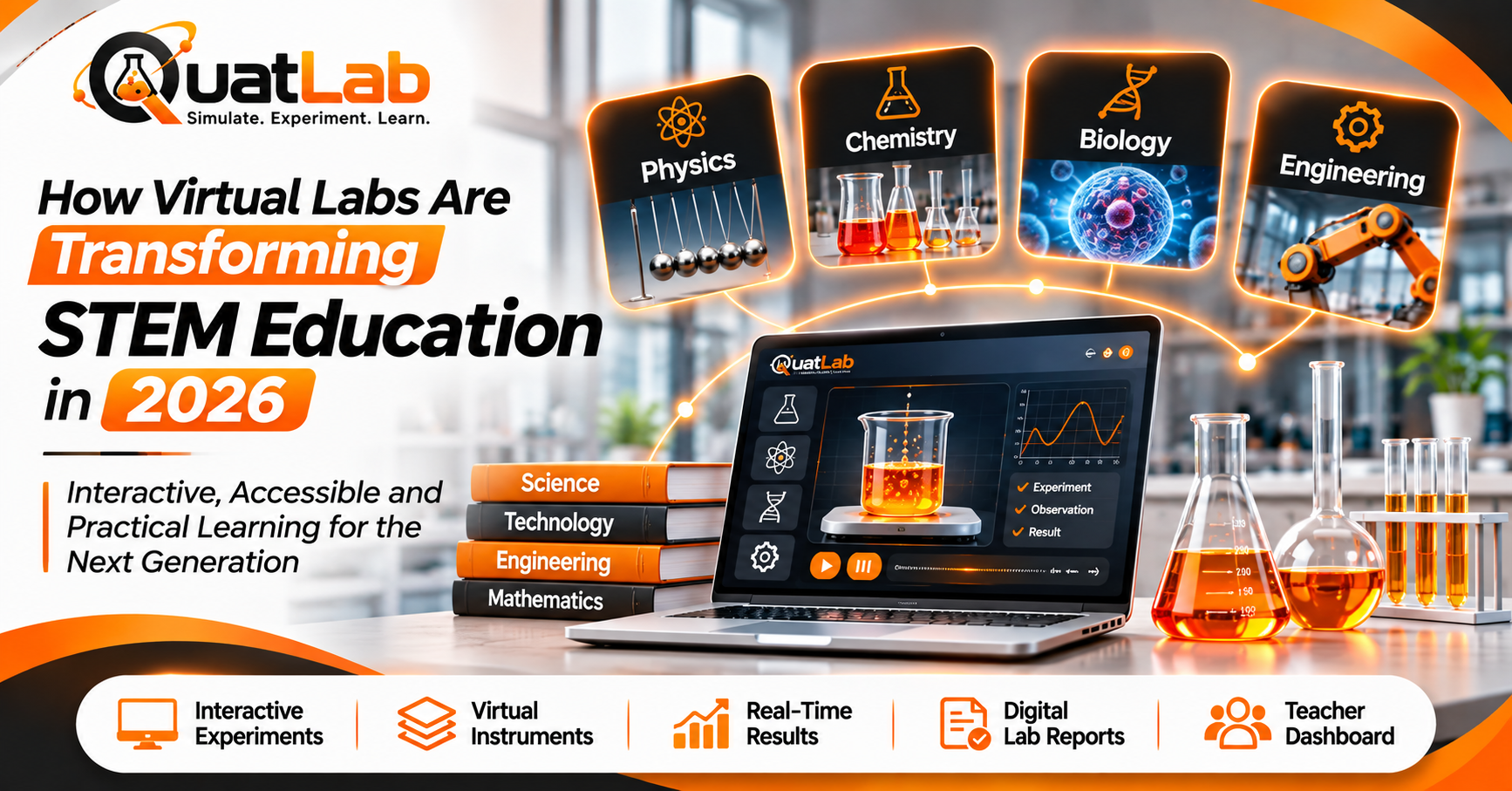
Platforms like QUATLAB bring multiple scientific disciplines together in one virtual learning environment.
Virtual Labs vs Traditional Labs: Key Differences
Understanding the differences between these two laboratory approaches can help educational institutions choose the right combination for their learning requirements.
1. Accessibility and Flexibility
Traditional laboratories generally operate according to institutional schedules. Students must access the physical facility during designated laboratory hours.
Virtual laboratories offer greater flexibility by allowing learners to access supported experiments through digital devices whenever the platform is available.
Winner: Virtual Labs for flexible access.
2. Learning Experience
Traditional labs provide direct interaction with physical instruments, materials and equipment.
Virtual labs offer interactive simulations where students can explore scientific concepts, change experimental parameters and observe different outcomes.
Both approaches contribute to practical understanding in different ways.
Winner: Both, depending on the learning objective.
3. Cost and Infrastructure
Setting up a traditional laboratory may require significant investment in equipment, furniture, chemicals, maintenance and safety arrangements.
Virtual laboratories can reduce dependence on certain physical resources and help institutions expand access to digital practical learning.
However, virtual platforms also require devices, software, connectivity and implementation support.
Winner: Virtual Labs for reducing dependence on physical infrastructure.
4. Safety and Experiment Repetition
Physical experiments may involve chemicals, electrical components, heat or other potential hazards. Appropriate safety procedures and supervision are essential.
Virtual simulations provide a controlled environment where students can repeat supported experiments without directly handling hazardous materials.
This makes them useful for preparation, demonstrations and conceptual exploration.
Winner: Virtual Labs for controlled simulation-based practice.
5. Practical Skill Development
Traditional laboratories help students develop physical skills such as handling instruments, preparing samples and operating equipment.
Virtual labs help learners understand procedures, experimental relationships and scientific concepts through interactive digital experiences.
Winner: Traditional Labs for physical equipment-handling skills.
Benefits of Virtual Laboratories in Modern Education
Virtual laboratories offer several opportunities to improve science and engineering education.
1. Learn Anytime, Anywhere
Students can access supported virtual experiments without always depending on physical laboratory schedules.
2. Repeat Experiments
Learners can repeat simulations to understand procedures, explore different parameters and improve their conceptual understanding.
3. Interactive Learning
Digital simulations encourage active participation rather than relying only on textbooks, lectures and static diagrams.
4. Better Understanding of Complex Concepts
Visual representations, interactive controls and experimental simulations can help explain difficult scientific principles.
5. Digital Reports and Assessments
Virtual laboratory platforms can support structured experiment documentation, quizzes, practical assessments and performance tracking.
6. Scalable Practical Learning
Educational institutions can extend digital practical learning opportunities across different classes, departments and disciplines.
Applications of Virtual Labs Across Different Subjects
Virtual laboratories can support practical learning across multiple scientific and engineering disciplines.
Physics Virtual Labs
Students can explore mechanics, optics, electricity, magnetism and thermodynamics through interactive simulations.
Chemistry Virtual Labs
Learners can study chemical reactions, titration, pH measurements, organic chemistry and analytical chemistry.
Biology Virtual Labs
Digital experiments can help students explore cell biology, genetics, microbiology, anatomy and plant biology.
Electronics Virtual Labs
Students can understand digital circuits, analog circuits, sensors, microcontrollers and circuit analysis.
Engineering Virtual Labs
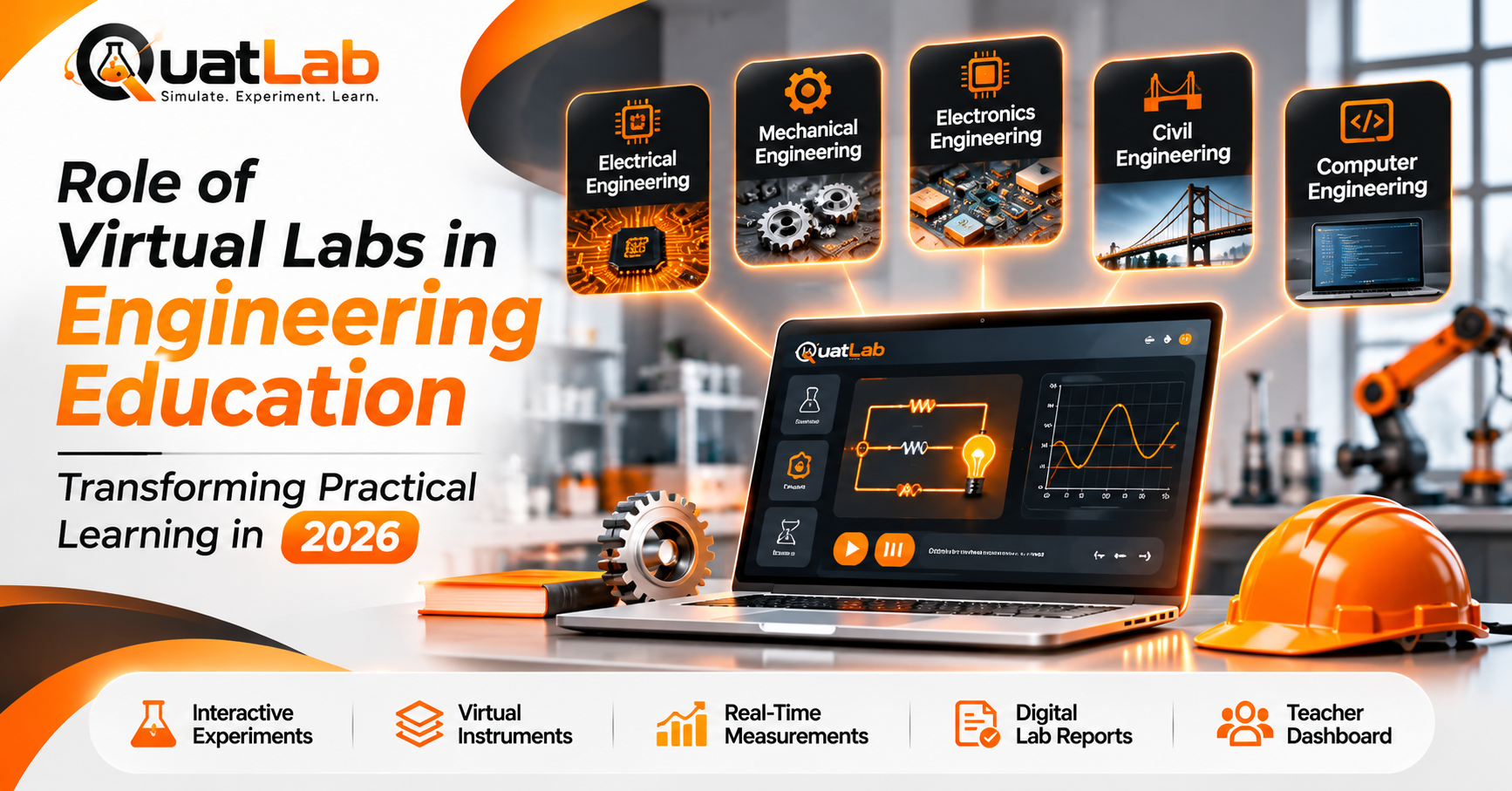
Virtual experiments can support electrical, mechanical, civil and computer science education.
How QUATLAB Supports Modern Practical Education
QUATLAB is designed to make practical learning more accessible, interactive and measurable through virtual laboratory technology.
Its virtual learning environment brings together interactive experiments, digital instruments, real-time measurements, data visualization and digital assessments.
What Makes QUATLAB Useful?
-
Interactive Experiments: Explore scientific concepts through digital simulations.
-
Virtual Instruments: Work with digital laboratory equipment and controls.
-
Real-Time Measurements: Observe experimental values and changing parameters.
-
Graphs and Analysis: Visualize experimental data and results.
-
Digital Lab Reports: Organize experiment objectives, procedures, observations and conclusions.
-
Digital Assessments: Evaluate theoretical knowledge and practical understanding.
-
Teacher Dashboard: Assign experiments and monitor student progress.
-
Learning Analytics: Understand experiment completion and assessment performance.
QUATLAB supports practical learning across Physics, Chemistry, Biology, Electronics and Engineering.
It provides students and educators with a connected digital environment to explore, practice and understand experiments.
Are Virtual Labs Replacing Traditional Laboratories?
Virtual laboratories are not necessarily a complete replacement for physical laboratories.
Both approaches have different strengths.
Traditional laboratories provide real-world equipment experience, physical interaction and opportunities to develop hands-on technical skills.
Virtual laboratories complement these experiences by providing flexible access, repeatable simulations and additional opportunities to understand scientific concepts.
A blended learning approach that combines physical experiments with virtual simulations can help institutions create a more comprehensive practical education experience.
The Future of Practical Learning
The future of science and engineering education will increasingly involve digital technologies, interactive simulations, intelligent learning tools and data-driven educational platforms.
Virtual laboratories can help educational institutions extend practical learning beyond traditional laboratory schedules.
As digital learning continues to evolve, platforms such as QUATLAB can support a more flexible, accessible and engaging approach to scientific experimentation.
Conclusion
Virtual laboratories and traditional laboratories both play valuable roles in modern education.
While traditional labs provide essential hands-on experience, virtual labs create additional opportunities for interactive learning, experiment repetition, digital assessments and flexible access.
For schools, colleges and universities, combining both approaches can help strengthen practical education and create more engaging learning experiences.
Ready to explore the future of practical learning?
Discover QUATLAB and experience a smarter way to simulate, experiment and learn.
Visit: https://www.quatlab.com/
Frequently Asked Questions (FAQs)
1. What is the difference between virtual labs and traditional labs?
Virtual labs use digital simulations to perform experiments, while traditional labs use physical equipment, materials and instruments.
2. Are virtual laboratories useful for science students?
Yes. Virtual laboratories can help students understand scientific concepts, practice experimental procedures and explore different outcomes through interactive simulations.
3. Can virtual labs replace physical laboratories?
Virtual labs can complement traditional laboratories, but they cannot fully replace physical equipment-handling and hands-on experimental skills.
4. Which subjects can be taught using virtual laboratories?
Virtual laboratories can support Physics, Chemistry, Biology, Electronics and various Engineering disciplines.
5. How do virtual labs help teachers?
They can help teachers assign experiments, evaluate student understanding, monitor progress and organize practical learning activities.
6. What is QUATLAB?
QUATLAB is a virtual laboratory platform designed to support interactive experiments, digital practical learning, assessments and educational analytics.
7. Can students repeat experiments in virtual labs?
Yes. Supported simulations allow students to repeat experiments and explore different parameters in a controlled digital environment.